
Balconette, plunge or triangle: bra styles explained
From full cup to longline, each bra style shapes and supports in its own way. Learn what they do, which breast shapes they suit and what to wear under which neckline.
Open a lingerie drawer that has been built with care and you will rarely find ten copies of the same bra. You will find a soft lace triangle for lazy Sundays, a smooth moulded cup for a fine knit, a balconette with a straight top edge for a square neckline. Each style exists for a reason. Knowing those reasons turns choosing a bra from trial and error into something closer to dressing: you look at the top, the day and your own shape, and you know what to reach for.
The main styles at a glance
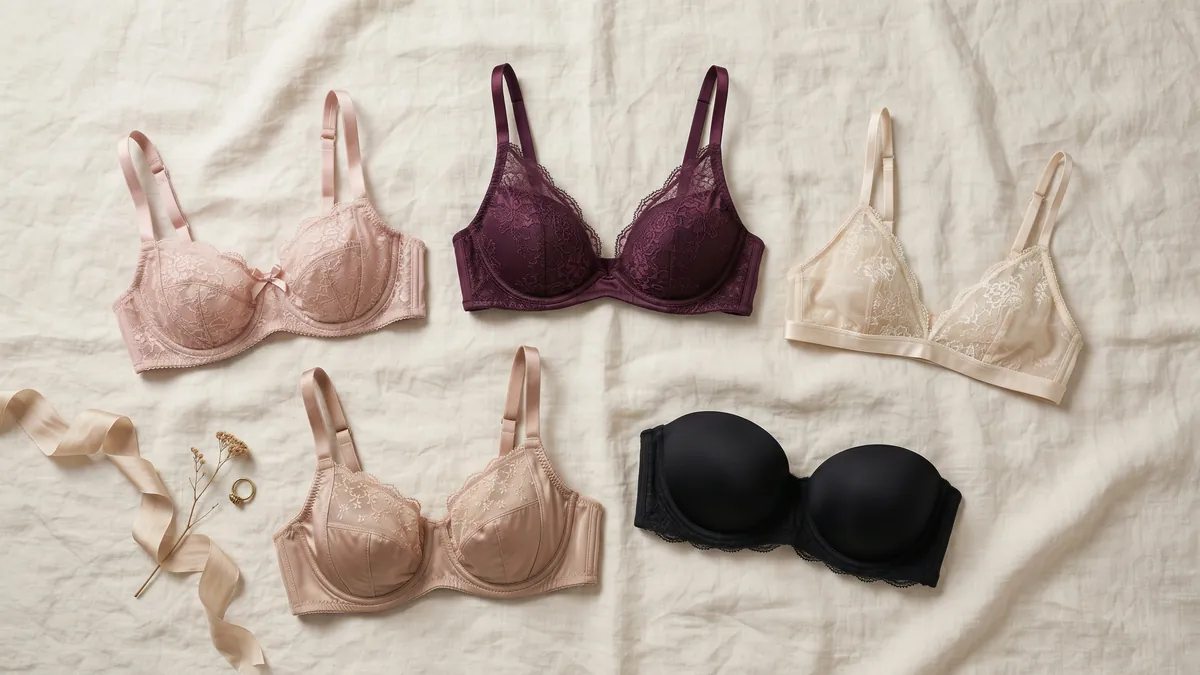
Most bras belong to a small family of cuts. The names vary a little from country to country, but the construction tells you what each one does.
| Style | What it does | Often suits |
|---|---|---|
| Full cup | Covers most of the breast, secure and smooth | Fuller busts, everyday wear, long busy days |
| Half cup or demi | Covers about half to three quarters, rounded neckline | Shallower shapes, wider necklines |
| Balconette | Wide set straps, horizontal top edge, lifts and rounds | Square and wide necklines, shallow or full on the bottom shapes |
| Plunge | Low centre gore, cups angled inwards | V necks, low cut tops, close set shapes |
| Triangle and bralette | Soft, often wireless and unlined, natural shape | Smaller to medium busts, comfort days |
| Moulded or t-shirt | Seamless foam or spacer cups, invisible under thin tops | Fine knits, jersey, smooth fabrics |
| Longline | Band extends down the ribcage, more stability | Vintage looks, fuller busts, strapless dresses |
A general guide. Your own shape and comfort matter more than any rule.
Alongside these sit a few specialists. A strapless or multiway bra relies on a wider band, a silicone grip along the inner edge and often a longline cut to stay put. A minimiser spreads the volume a little wider and flatter, which some people like under buttoned blouses. A soft cup bra with inner support slings gives lift without a wire.
Wired or wireless
For a long time wireless meant soft and not much else. That has changed. Seamed cups, inner slings, firmer power mesh and wider bands now give wireless bras real support, including in fuller cup sizes. Underwires still have their place: they define the shape, separate the breasts and hold a structured line under tailored clothes.
The choice is personal. If a wire digs in, it is usually the wrong width or the wrong size, not proof that wires are wrong for you. A fitting with a few different wire widths often solves the problem in minutes. If you love the freedom of wireless, look for a firm band and seams rather than a single stretchy layer.
Why shape matters more than size
Two people in the same size can need entirely different bras, because breasts differ in shape as much as in volume. A few simple ideas describe most of those differences, and none of them is better or worse than another.
- Shallow or projected: shallow shapes spread their volume wider across the chest; projected shapes extend further forward from a narrower base.
- Full on top or full on the bottom: some breasts carry more volume in the upper half, others in the lower half.
- Close set or wide set: the space between the breasts can be narrow or generous.
- Narrow or wide roots: the root is where the breast meets the chest wall, and it decides how wide the wire should be.
As a starting point, shallow shapes often get on well with balconettes and half cups, whose cups are wide and open. Projected shapes often prefer deeper cups with seams, which give the room a moulded cup cannot. Close set shapes tend to like a plunge, wide set shapes a balconette. These are tendencies, not laws, and trying a style on is the only real test.
Two people in the same size can need entirely different bras, because breasts differ in shape as much as in volume.
Which bra under which neckline
The most satisfying use of all this knowledge is dressing. A bra that shows its straps at the edge of a neckline, or a seam pressing through silk, can unsettle an otherwise lovely outfit. A short neckline guide helps.
- Crew neck and high necks: almost anything works; a smooth t-shirt bra under thin jersey.
- V neck and deep V: a plunge, so the centre gore stays hidden below the point of the neckline.
- Square and sweetheart: a balconette, whose straight top edge and wide set straps follow the line.
- Scoop neck: a half cup or demi for a rounded upper edge.
- Off the shoulder and bandeau: a strapless or multiway bra, ideally with a longline band.
- Racer back and halter: a multiway bra with crossable straps or a halter option.
- Sheer blouses: a bra close to your skin tone, or a pretty lace bralette worn on purpose.
Building a small, sensible collection
Few people need every style. Three to five bras that rotate well are usually enough for daily life: one or two smooth everyday bras, one lace piece you love simply for itself, and one specialist that matches the necklines you actually wear. A strapless can wait until the summer wedding that calls for it.
Rotating also helps the bras. Elastic recovers best when it rests for a day between wears, and gentle hand washing in cool water keeps both lace and power mesh lively for longer. Store moulded cups nested inside each other, never folded, so the foam keeps its curve.
Most of all, choose styles that make you feel at home in yourself. A bra is a quiet companion for the day. The right one feels like nothing at all, and that is the highest compliment it can earn.
Questions and answers
What is the difference between a balconette and a demi bra?
A balconette has wide set straps and a horizontal top edge that lifts and rounds. A demi or half cup covers about half to three quarters of the breast with a softer, rounded edge. The two overlap, and makers use the names a little differently.
Is a wireless bra supportive enough for a fuller bust?
Often, yes. Look for seamed cups, inner support slings and a firm, wide band rather than a single layer of stretch. Comfort and support depend more on construction than on the wire.
Why does my plunge bra gape?
Plunge cups are angled inwards and cut low, which suits close set and fuller on top shapes. If the upper cup gapes, a balconette or a half cup may follow your shape better.
How do I stop a strapless bra slipping?
Choose a firm band, possibly one size smaller in the band with a larger cup, a silicone grip along the edge and a longline cut. Fasten it, then pull it down slightly at the back so the band sits level.
Further reading in our network
- GlamesiaFashion and beauty
Fashion and beauty, with ideas for necklines, wardrobes and getting dressed with ease.
- RonestaWomen’s lifestyle
Women’s lifestyle with calm ideas for everyday wellbeing, wardrobe and confidence.
Our articles are general information written with care. Sizes and conversions are guide values that differ between makers; for health questions please talk to a doctor or midwife.