
From French knickers to high-waist: a guide to briefs
Full brief, bikini, hipster, French knickers or seamless: what each style is for, how it should fit, which fabrics are kind to skin and when it is time to replace a pair.
Briefs are the quietest part of any wardrobe. Nobody compliments them, and on a good day you forget you are wearing them at all. Yet they decide a great deal: whether a silk skirt falls cleanly, whether a long train journey feels comfortable, whether a fine knit dress shows a line across the hip. Folded in a drawer they look almost alike. Worn, they behave very differently, and a few minutes spent understanding the styles saves a great many small daily irritations.
The styles, from full to minimal
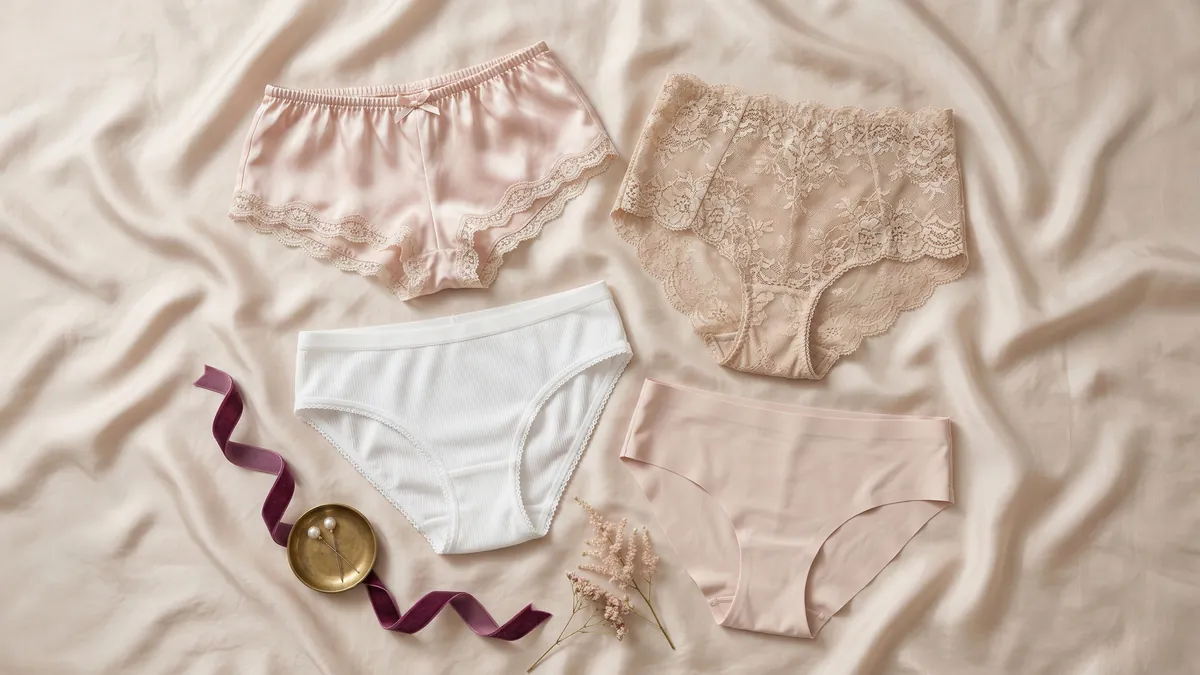
The family of briefs runs from generous coverage to very little, and each cut has its moment. Names vary a little between makers, but the shape of the waist and the leg opening tell you which one you are holding.
| Style | How it sits | Good for |
|---|---|---|
| Classic or full brief | Full coverage at front and back, waist near the navel | Everyday comfort, long days |
| High-waist brief | Reaches the natural waist | Smooth lines under high trousers and skirts, a vintage look |
| Midi brief | Between full brief and bikini | A balanced everyday cut |
| Bikini brief | Lower at the waist, higher at the leg | Low rise trousers, a lighter feel |
| Hipster or boyshort | Sits on the hips with a straight leg line | Under skirts and dresses, relaxed days |
| French knickers | Loose, flowing leg like little shorts | Under skirts and dresses, often silk |
| Tanga and Brazilian | Less coverage at the back, more than a thong | Fitted clothes, a lighter look |
| Thong | Minimal back | Very tight clothes with no visible lines |
| Seamless laser cut | No elastic edges | Invisible under thin, close fabrics |
A general guide. Comfort and how a cut feels on you matter more than any category.
French knickers and the art of drape
French knickers deserve a moment of their own. Their name comes from early twentieth century fashion, when looser, lighter underthings replaced heavier layers. Cut wide at the leg and often made of silk or a fluid satin, they move with you instead of hugging the skin. Under a bias cut skirt or a floating summer dress they glide rather than cling, and they feel wonderfully airy on warm evenings.
Look for a gently shaped waistband that sits flat, French seams or neatly bound edges inside, and a cotton or silk gusset. A little lace at the hem is lovely, as long as it is soft enough not to scratch the thigh.
Fabrics that are kind to skin
Whatever the outer fabric, the gusset is what touches the most sensitive skin, and cotton remains the classic choice there: breathable, washable at higher temperatures and gentle. Modal, a soft cellulose fibre, is cool and smooth and holds its shape well. Silk is light and luxurious, best kept for gentler days and hand washing.
Lace briefs need not be scratchy. The good ones finish the leg with a scalloped lace edge that is soft and lies flat, rather than a hard elastic that digs in. Run your fingertips along the inside of the edge before buying: if it feels rough there, it will feel rougher after a day of wear.
- For sensitive skin: a cotton gusset, flat seams, soft edges and as few labels as possible; cut the label off carefully if it bothers you.
- For warm weather: cotton, modal or silk, and looser cuts such as French knickers.
- Under fine knits: seamless laser cut edges, in a tone close to your skin rather than white.
How briefs should fit
A well fitting pair is almost unnoticeable. The waistband lies flat without rolling over, the leg openings follow the body without cutting in, and the back stays in place when you sit, walk and bend. If the waistband folds down or the edges leave red marks, the size or the cut is wrong, not your body.
If the edges leave red marks, the size or the cut is wrong, not your body.
When you are between sizes, size up rather than down. A slightly roomier brief stays comfortable all day; a tight one shifts, rolls and draws lines exactly where you hoped it would not. Briefs follow dress sizes, which vary between makers, so check the chart for each new style. Try a new cut sitting down as well as standing, since a waistband that feels fine in the mirror can press once you settle into a chair for an afternoon at your desk.
Matching sets or a mixed drawer
A matching set has a lovely calm about it: the same lace, the same colour, a sense of being finished. Many people buy two briefs for each bra, since briefs are washed more often. Mixing has its pleasures too. A drawer of neutral tones, ivory, nude shades, black and grey, combines with almost any bra, and a few pieces in a favourite colour add some joy.
How many to own, care and when to replace
There is no fixed number, but enough pairs for a week or a little more, plus a few for special occasions, keeps the rotation easy and spares each pair. Wash cotton everyday pieces at moderate temperatures, lace and silk by hand or in a mesh bag on a gentle cycle, and dry them flat or hanging, away from direct heat. Tumble dryers are hard on elastic.
- Replace a pair when the waistband or leg elastic has lost its spring and no longer lies flat.
- Replace it when the gusset fabric has thinned or pilled.
- Replace it when lace has torn at the seams or the edges have started to fray.
- Replace it when it simply no longer feels pleasant, which is a perfectly good reason.
A drawer of briefs that fit, feel soft and suit the clothes you love is a small, steady luxury. You notice it most on the days when you do not notice it at all.
Questions and answers
Which briefs are invisible under tight clothes?
Seamless laser cut briefs have no elastic edges and are the most discreet. A thong or tanga avoids lines at the back, and a tone close to your skin is less visible than white under pale fabrics.
Are lace briefs uncomfortable?
Not when they are well made. Look for a soft scalloped lace edge rather than a hard elastic, a cotton gusset and flat seams, and feel the inside of the edge before you buy.
Should briefs be tight?
No. The waistband should lie flat without rolling and the leg openings should follow the body without cutting in. If you are between sizes, choose the larger one.
How often should I replace briefs?
There is no fixed timetable. Replace a pair when the elastic has lost its spring, the gusset has thinned, the lace is torn or it simply no longer feels pleasant.
Further reading in our network
- GlamesiaFashion and beauty
Fashion and beauty, with ideas for wardrobes, colours and getting dressed with ease.
Our articles are general information written with care. Sizes and conversions are guide values that differ between makers; for health questions please talk to a doctor or midwife.