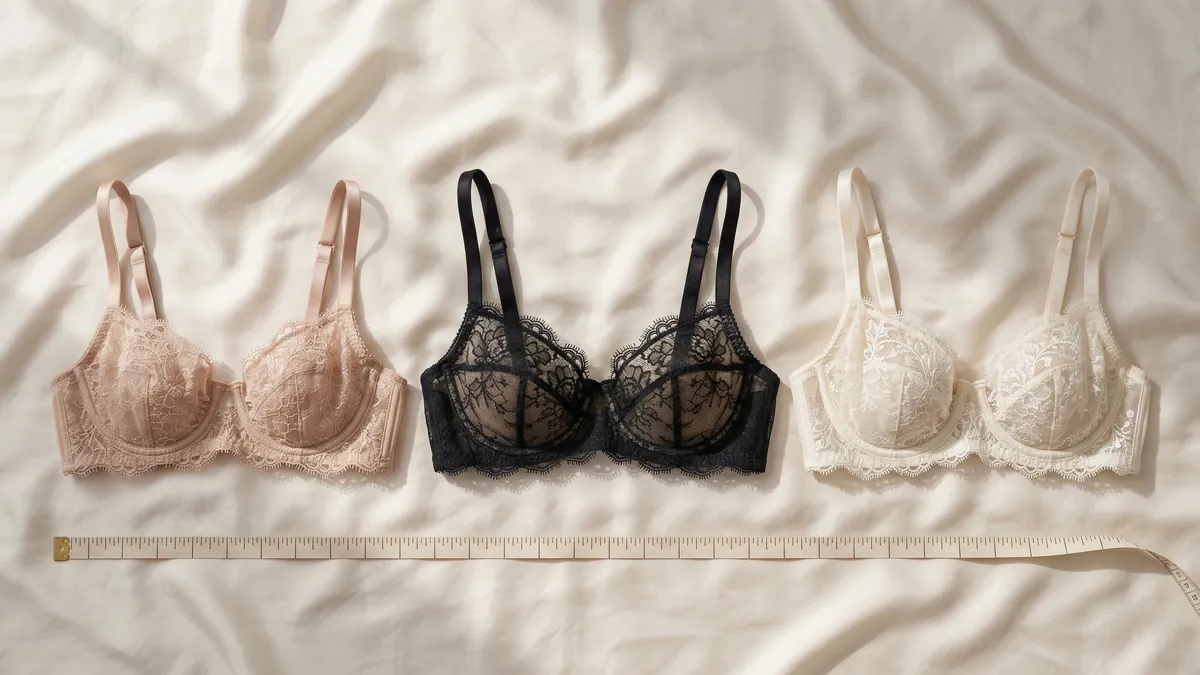

Sister sizes and international bra sizes made simple
Why 75C, 70D and 80B can hold the same cup, how EU, French, UK and US labels relate, and how to convert sizes with care rather than guesswork.
Lay three bras side by side on a white bedspread: a 75C, a 70D and an 80B. Look closely at the cups and something surprising appears. They are close to the same depth and volume, as if cut from one pattern. Only the bands tell them apart. This is the quiet logic behind sister sizes, and once it clicks, bra labels stop feeling like a code you were never taught. It also explains why a letter on its own says very little about a bra.
Why a cup letter is never on its own
A cup letter does not describe a fixed volume. It describes a difference: how much larger the bust is than the underbust. So a C cup on a 70 band is smaller than a C cup on an 85 band, because the whole frame is smaller. The letter only has meaning in relation to the number in front of it.
This is why so many people are surprised by their measured size. A D or an E sounds large to some ears, but on a narrow band it may describe a perfectly modest cup. Letters are not a judgement or a category, simply a ratio.
How sister sizes work
When you go down one band size, you go up one cup letter to keep about the same cup volume. When you go up one band size, you go down one letter. In EU sizes, 75C, 70D and 80B are sister sizes: the cups hold roughly the same, while the band is tighter or looser.
| Smaller band | Your size | Larger band |
|---|---|---|
| 70D | 75C | 80B |
| 65E | 70D | 75C |
| 75D | 80C | 85B |
| 80E | 85D | 90C |
| 70F | 75E | 80D |
EU sizes, rough guide values. Sister sizes share about the same cup volume, but the fit always depends on the cut and the maker.
Sister sizes are a tool for one sideways step, sometimes two. Go much further and the proportions change: the wires become too wide or too narrow, and the straps sit in the wrong place.
When to use them in the fitting room
The most useful moment is when the cups fit well but the band does not. Two situations come up again and again, and both have a simple answer.
- The band is too loose and rides up at the back, even on the tightest hook, while the cups feel right: go down one band size and up one cup letter, for example from 80B to 75C.
- The band is too tight and presses on the ribcage, while the cups feel right: go up one band size and down one cup letter, for example from 70D to 75C.
- The cups gape or overflow but the band is perfect: here sister sizes do not help. Keep the band and change the cup letter, or try a different style.
- Your usual size is sold out in a style you love: the sister size is worth trying on, but check the band carefully, because it will feel different.
The cup letter only means something next to the number in front of it.
Many people habitually choose a band that is too large and a cup that is too small, because the band feels gentler at first. A firmer band with a deeper cup often turns out to be far more comfortable by the end of the day, since the support no longer hangs from the shoulders.
International systems side by side
Travelling, or ordering from another country, brings a second puzzle: the labels themselves change. The main systems work like this, and every conversion below is a rough guide value rather than a rule.
- EU: band in centimetres in steps of 5 (70, 75, 80 and so on), cups A, B, C, D, E, F, G.
- France and Belgium: the band number is about 15 higher than the EU number, so EU 75 is French 90; cup letters follow the EU pattern.
- UK: band in inches (32, 34, 36 and so on), cups A, B, C, D, DD, E, F, FF, G and onwards.
- US: band in inches like the UK, but the letters after D differ between makers, for example DD and DDD.
- Australia and New Zealand: their own band numbers, based on dress sizes.
| EU band | French band | UK and US band |
|---|---|---|
| 65 | 80 | 30 |
| 70 | 85 | 32 |
| 75 | 90 | 34 |
| 80 | 95 | 36 |
| 85 | 100 | 38 |
| 90 | 105 | 40 |
Rough guide values. Makers round differently, so always check the size chart of the piece you are buying.
Converting cup letters with care
Bands convert fairly neatly. Cups are where people go astray. Up to D, EU and UK letters tend to sit close together. Beyond D they diverge, because the UK adds double letters such as DD, FF and GG, while the EU simply moves on through the alphabet. A UK F and an EU F are therefore not the same cup, and the gap grows as the letters climb.
US letters add another layer, since makers label the larger cups in different ways. If you are unsure, keep a note on your phone with your underbust and bust in centimetres. Those two numbers travel well across every system, and they make any size chart readable in a minute or two. When a style runs small or large, reviews and fitting notes from the maker are worth reading before you order.
Briefs, bodies and the rest of the wardrobe
Sister sizes belong to bras alone. Briefs, slips, robes and most nightwear follow ordinary dress sizes or simple letter sizes such as S, M and L, and these too vary between countries. Bodies and longline pieces often combine both: a band and cup for the top, and a dress size for the rest, so read the chart line by line.
Above all, use every conversion as a starting point. A label is a promise from one maker, not a description of you. The truest size is the one that sits level, holds calmly and lets you forget it is there.
Questions and answers
Is a 34C the same as a 75C?
As a rough guide the bands match, since UK 34 is about EU 75. Up to D the cups are close too, but makers round differently, so check the size chart for each piece.
Can I always wear my sister size?
A sister size is worth trying when your usual size is unavailable or the band feels wrong, but it changes the band fit. One step sideways usually works; further steps alter the wire width and strap position too much.
Why are French sizes so different?
France and Belgium use a band number about 15 higher than the EU system, so EU 75 corresponds to French 90. The cup letters follow the same pattern as the EU.
Do briefs have sister sizes?
No. Briefs, slips and most nightwear follow dress sizes or letter sizes such as S, M and L, which also vary between countries and makers.
Further reading in our network
- GlamesiaFashion and beauty
Fashion and beauty, with ideas for wardrobes, colours and getting dressed with ease.
Our articles are general information written with care. Sizes and conversions are guide values that differ between makers; for health questions please talk to a doctor or midwife.